Multiple linear regression
January 22, 2026
Announcements
- HW 01 - due Thursday, January 29 at 11:59pm
Topics
Introducing multiple linear regression
Exploratory data analysis for multiple linear regression
Fitting the least squares line
Interpreting coefficients for quantitative predictors
Prediction
Comparing models
Computing setup
Data: Peer-to-peer lender
Today’s data is a sample of 50 loans made through a peer-to-peer lending club. The data is in the loan50 data frame in the openintro R package.
# A tibble: 50 × 4
   annual_income debt_to_income verified_income interest_rate
           <dbl>          <dbl> <fct>                   <dbl>
 1         59000         0.558  Not Verified            10.9
 2         60000         1.31   Not Verified             9.92
 3         75000         1.06   Verified                26.3
 4         75000         0.574  Not Verified             9.92
 5        254000         0.238  Not Verified             9.43
 6         67000         1.08   Source Verified          9.92
 7         28800         0.0997 Source Verified         17.1
 8         80000         0.351  Not Verified             6.08
 9         34000         0.698  Not Verified             7.97
10         80000         0.167  Source Verified         12.6
# ℹ 40 more rows
Variables
Predictors:
annual_income: Annual incomedebt_to_income: Debt-to-income ratio, i.e. the percentage of a borrower’s total debt divided by their total incomeverified_income: Whether borrower’s income source and amount have been verified (Not Verified,Source Verified,Verified)
Response: interest_rate: Interest rate for the loan
Response: interest_rate
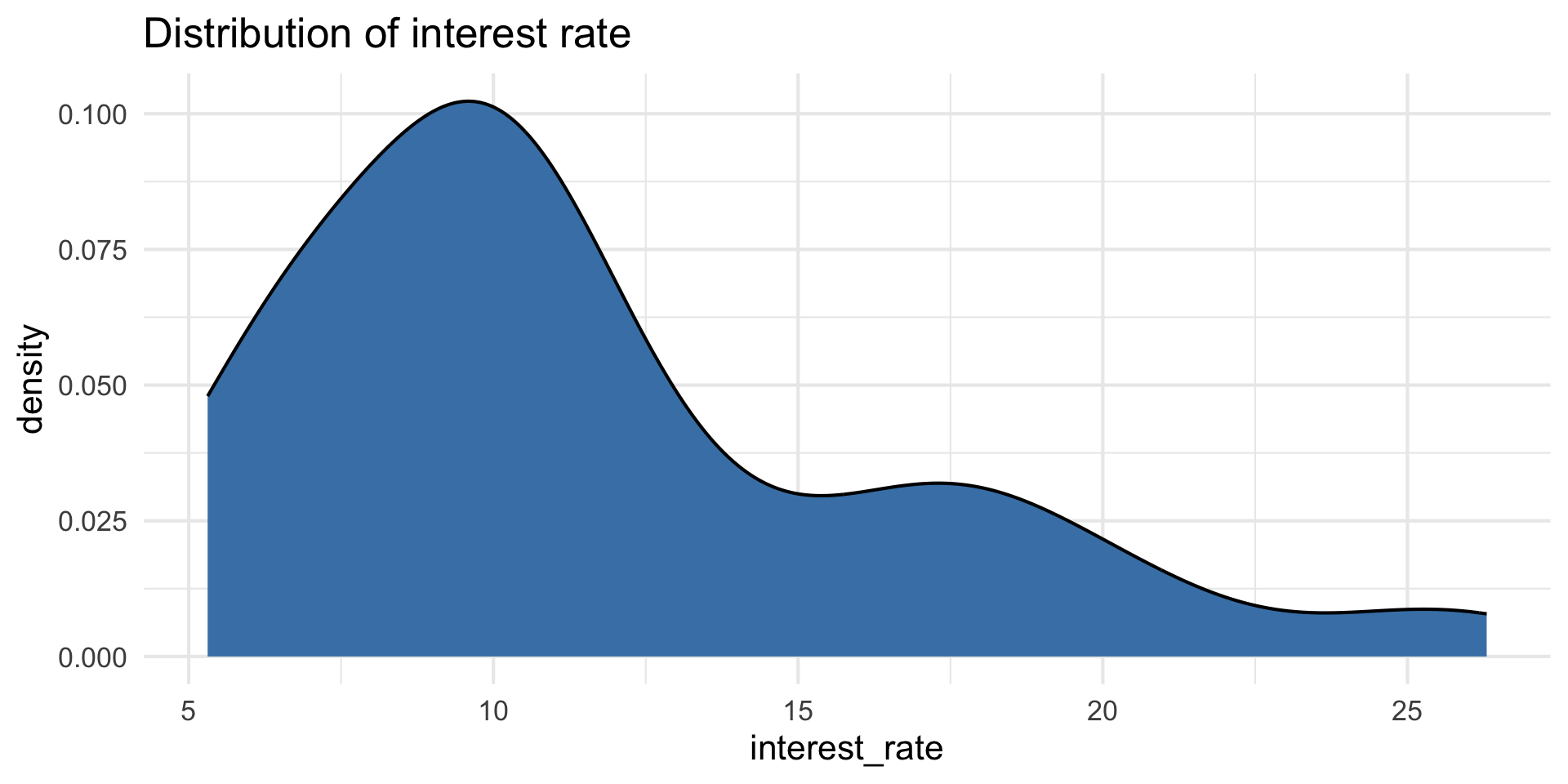
| Min | Median | Max | IQR |
|---|---|---|---|
| 5.31 | 9.93 | 26.3 | 5.755 |
Predictors
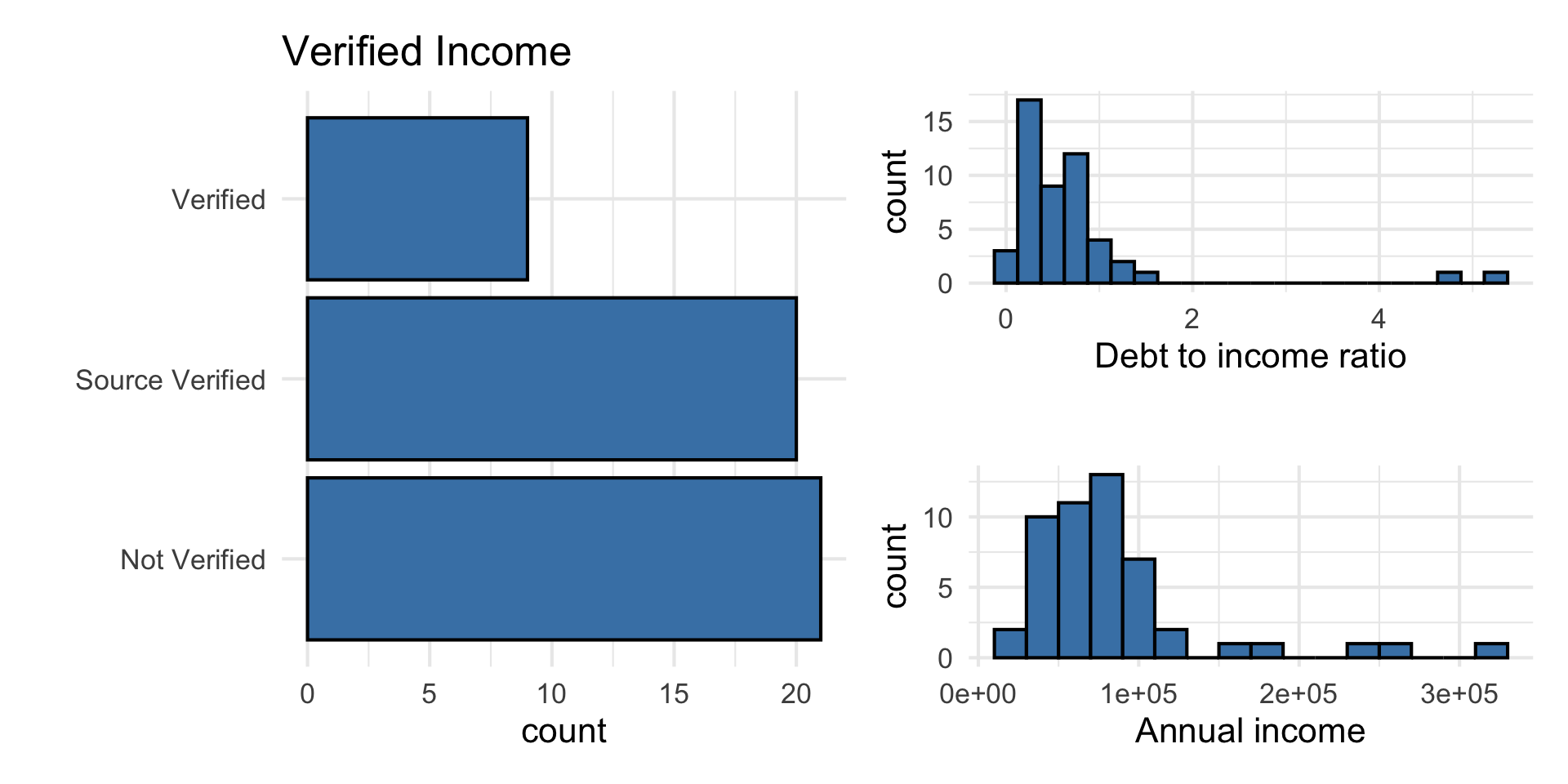
Data manipulation 1: Rescale income
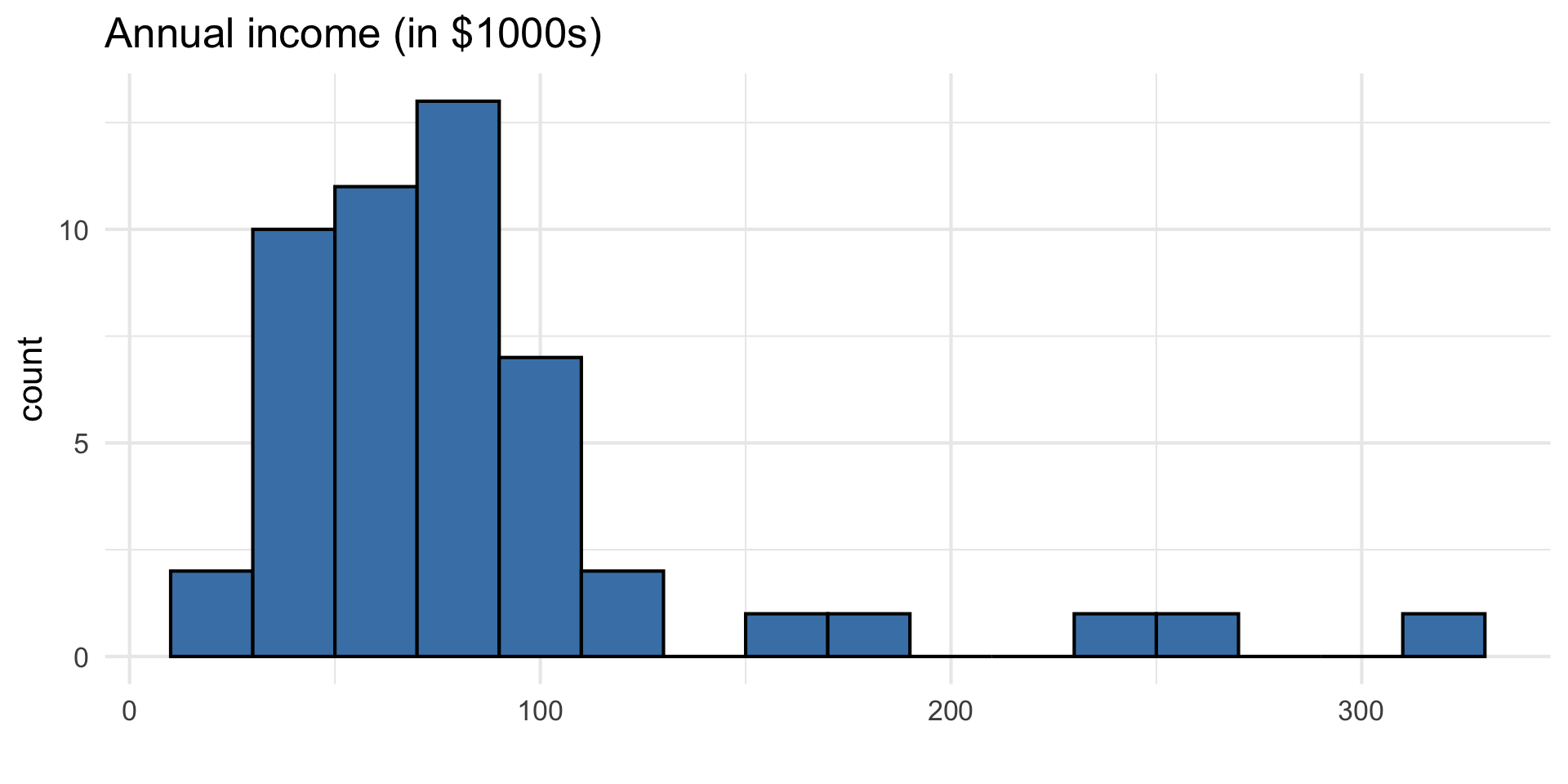
Why did we rescale income?
Outcome vs. predictors
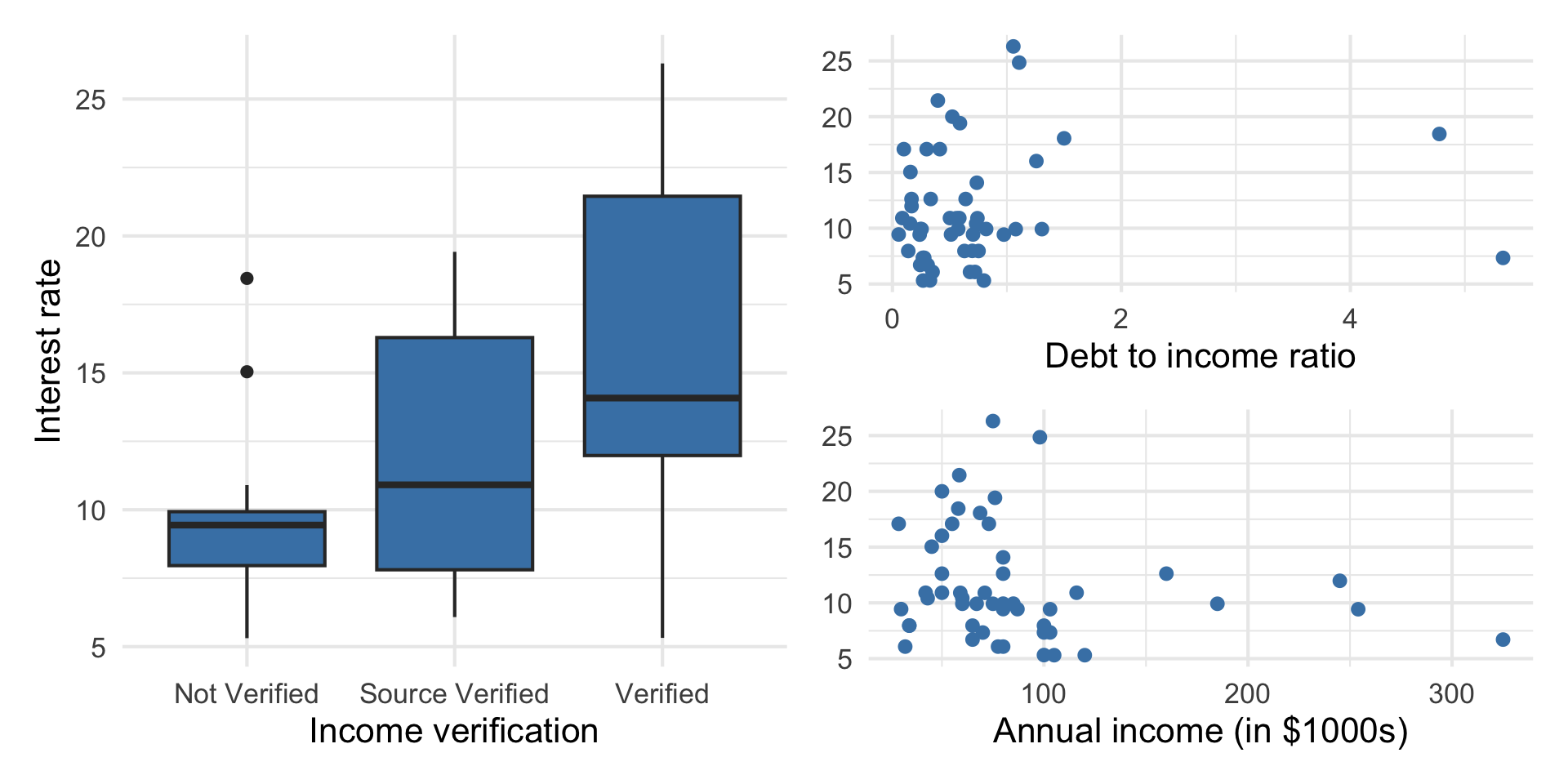
Goal: Use these predictors in a single model to understand variability in interest rate.
Why do we want to use a single model versus 3 separate simple linear regression models?
Multiple linear regression (MLR)
Multiple linear regression (MLR)
Based on the analysis goals, we will use a multiple linear regression model of the following form
\[ \begin{aligned}\text{interest_rate} ~ = \beta_0 & + \beta_1 ~ \text{debt_to_income} \\ & + \beta_2 ~ \text{verified_income}_1 \\ &+ \beta_3 ~ \text{verified_income}_2 \\ &+\beta_4~ \text{annual_income_th} \\ & +\epsilon, \quad \epsilon \sim N(0, \sigma^2_{\epsilon}) \end{aligned} \]
Multiple linear regression
Recall: The simple linear regression model
\[ Y = \beta_0 + \beta_1~ X + \epsilon \]
The form of the multiple linear regression model is
\[ Y = \beta_0 + \beta_1X_1 + \dots + \beta_pX_p + \epsilon \]
Therefore,
\[ E(Y|X_1, \ldots, X_p) = \beta_0 + \beta_1X_1 + \dots + \beta_pX_p \]
Fitting the least squares line
Similar to simple linear regression, we want to find estimates for \(\beta_0, \beta_1, \ldots, \beta_p\) that minimize
\[ \sum_{i=1}^{n}\epsilon_i^2 = \sum_{i=1}^n[y_i - \hat{y}_i]^2 = \sum_{i=1}^n[y_i - (\beta_0 + \beta_1x_{i1} + \dots + \beta_px_{ip})]^2 \]
The calculations can be very tedious, especially if \(p\) is large
Matrix form of multiple linear regression
Suppose we have \(n\) observations, a quantitative response variable, and \(p\) > 1 predictors \[ \underbrace{ \begin{bmatrix} y_1 \\ \vdots \\ y_n \end{bmatrix} }_ {\mathbf{y}} \hspace{3mm} = \hspace{3mm} \underbrace{ \begin{bmatrix} 1 &x_{11} & \dots & x_{1p}\\ \vdots & \vdots &\ddots & \vdots \\ 1 & x_{n1} & \dots &x_{np} \end{bmatrix} }_{\mathbf{X}} \hspace{2mm} \underbrace{ \begin{bmatrix} \beta_0 \\ \beta_1 \\ \vdots \\ \beta_p \end{bmatrix} }_{\boldsymbol{\beta}} \hspace{3mm} + \hspace{3mm} \underbrace{ \begin{bmatrix} \epsilon_1 \\ \vdots\\ \epsilon_n \end{bmatrix} }_\boldsymbol{\epsilon} \]
What are the dimensions of \(\mathbf{y}\), \(\mathbf{X}\), \(\boldsymbol{\beta}\), \(\boldsymbol{\epsilon}\)?
Matrix form of multiple linear regression
As with simple linear regression, we have
\[ \mathbf{Y} = \mathbf{X}\boldsymbol{\beta} + \boldsymbol{\epsilon} \]
Generalizing the derivations from SLR to \(p > 2\), we have
\[ \hat{\boldsymbol{\beta}} = (\mathbf{X}^ \mathsf{T}\mathbf{X})^{-1}\mathbf{X}^\mathsf{T}\mathbf{y} \]
as before.
Model fit in R
| term | estimate | std.error | statistic | p.value |
|---|---|---|---|---|
| (Intercept) | 10.726 | 1.507 | 7.116 | 0.000 |
| debt_to_income | 0.671 | 0.676 | 0.993 | 0.326 |
| verified_incomeSource Verified | 2.211 | 1.399 | 1.581 | 0.121 |
| verified_incomeVerified | 6.880 | 1.801 | 3.820 | 0.000 |
| annual_income_th | -0.021 | 0.011 | -1.804 | 0.078 |
Model equation
\[ \begin{align}\hat{\text{interest_rate}} = 10.726 &+0.671 \times \text{debt_to_income}\\ &+ 2.211 \times \text{source_verified}\\ &+ 6.880 \times \text{verified}\\ & -0.021 \times \text{annual_income_th} \end{align} \]
Note
We will talk about why there are only two terms in the model for verified_income soon!
Interpreting \(\hat{\beta}_j\)
- The estimated coefficient \(\hat{\beta}_j\) is the expected change in the mean of \(Y\) when \(X_j\) increases by one unit, holding the values of all other predictor variables constant.
- Example: The estimated coefficient for
debt_to_incomeis 0.671. This means for each point in an borrower’s debt to income ratio, the interest rate on the loan is expected to be greater by 0.671%, on average, holding annual income and income verification constant.
Interpreting \(\hat{\beta}_j\)
The estimated coefficient for annual_income_th is -0.021. Interpret this coefficient in the context of the data.
Why do we need to include a statement about holding all other predictors constant?
Interpreting \(\hat{\beta}_0\)
| term | estimate | std.error | statistic | p.value | conf.low | conf.high |
|---|---|---|---|---|---|---|
| (Intercept) | 10.726 | 1.507 | 7.116 | 0.000 | 7.690 | 13.762 |
| debt_to_income | 0.671 | 0.676 | 0.993 | 0.326 | -0.690 | 2.033 |
| verified_incomeSource Verified | 2.211 | 1.399 | 1.581 | 0.121 | -0.606 | 5.028 |
| verified_incomeVerified | 6.880 | 1.801 | 3.820 | 0.000 | 3.253 | 10.508 |
| annual_income_th | -0.021 | 0.011 | -1.804 | 0.078 | -0.043 | 0.002 |
Describe the subset of borrowers who are expected to get an interest rate of 10.726% based on our model. Is this interpretation meaningful? Why or why not?
Prediction
What is the predicted interest rate for an borrower with an debt-to-income ratio of 0.558, whose income is not verified, and who has an annual income of $59,000?
The predicted interest rate for an borrower with with an debt-to-income ratio of 0.558, whose income is not verified, and who has an annual income of $59,000 is 9.86%.
Prediction in R
Just like with simple linear regression, we can use the predict() function in R to calculate the appropriate intervals for our predicted values:
       1
9.890888
Note
Difference in predicted value due to rounding the coefficients on the previous slide.
Cautions
- Do not extrapolate! Because there are multiple predictor variables, there is the potential to extrapolate in many directions
- The multiple regression model only shows association, not causality
- To show causality, you must have a carefully designed experiment or carefully account for confounding variables in an observational study (causal inference)
Model comparison
Model evaluation: RMSE & \(R^2\)
Root mean square error, RMSE: A measure of the average error (average difference between observed and predicted values of the outcome)
R-squared, \(R^2\) : Percentage of variability in the outcome explained by the regression model
Comparing models
Let’s consider the following models:
| term | Model 1 | Model 2 |
|---|---|---|
| (Intercept) | 10.726 | 9.560 |
| debt_to_income | 0.671 | 0.691 |
| verified_incomeSource Verified | 2.211 | 3.577 |
| verified_incomeVerified | 6.880 | 9.923 |
| annual_income_th | -0.021 | -0.007 |
| verified_incomeSource Verified:annual_income_th | NA | -0.016 |
| verified_incomeVerified:annual_income_th | NA | -0.032 |
Comparing models
When comparing models, do we prefer the model with the lower or higher RMSE?
Though we use \(R^2\) to assess the model fit, it is generally unreliable for comparing models with different number of predictors. Why?
\(R^2\) will stay the same or increase as we add more variables to the model.
If we only use \(R^2\) to choose a best fit model, we will be prone to choose the model with the most predictor variables.
Adjusted \(R^2\)
- Adjusted \(R^2\): measure that includes a penalty for unnecessary predictor variables
- Similar to \(R^2\), it is a measure of the amount of variation in the response that is explained by the regression model
- Use the
glance()function to get \(Adj. R^2\) in R
\(R^2\) and Adjusted \(R^2\)
\[R^2 = \frac{SSM}{SST} = 1 - \frac{SSR}{SST}\]
\[R^2_{adj} = 1 - \frac{SSR/(n-p-1)}{SST/(n-1)}\]
where
\(n\) is the number of observations used to fit the model
\(p\) is the number of non-intercept terms in the model
Using \(R^2\) and Adjusted \(R^2\)
- Adjusted \(R^2\) can be used as a quick assessment to compare the fit of multiple models; however, it should not be the only assessment
- Use \(R^2\) when describing the relationship between the response and predictor variables
Comparing interest rate models
Recap
Showed exploratory data analysis for multiple linear regression
Used least squares to fit the regression line
Interpreted the coefficients for quantitative predictors
Predicted the response for new observations
Introduced \(Adj. R^2\) for comparing models
Questions
For next class
Types of predictors
Complete Lecture 06 prepare