Multicollinearity
Feb 24, 2026
Announcements
Project proposal due TODAY at 11:59pm on GitHub
February 25, 5-6 pm @ East Duke 108: Duke Sports Analytics Club is hosting Sam Marks, Director of Business Strategy and Analytics at the Boston Bruins
- Click here to register
SSMU Mini DataFest #2: February 27 - March 1. Click here for announcement
March 20 - 22: ASA DataFest at Duke
- Learn more and register: https://dukestatsci.github.io/datafest/#signup
Computing set up
Topics
Model conditions and diagnostics
Multicollinearity
Definition
How it impacts the model
How to detect it
What to do about it
Model conditions and diagnostics
Assumptions for regression
\[ \mathbf{y}|\mathbf{X} \sim N(\mathbf{X}\boldsymbol{\beta}, \sigma_\epsilon^2\mathbf{I}) \]
- Linearity: There is a linear relationship between the response and predictor variables.
- Equal variance: The variability about the least squares line is generally constant.
- Normality: The distribution of the errors (residuals) is approximately normal.
- Independence: The errors (residuals) are independent from one another.
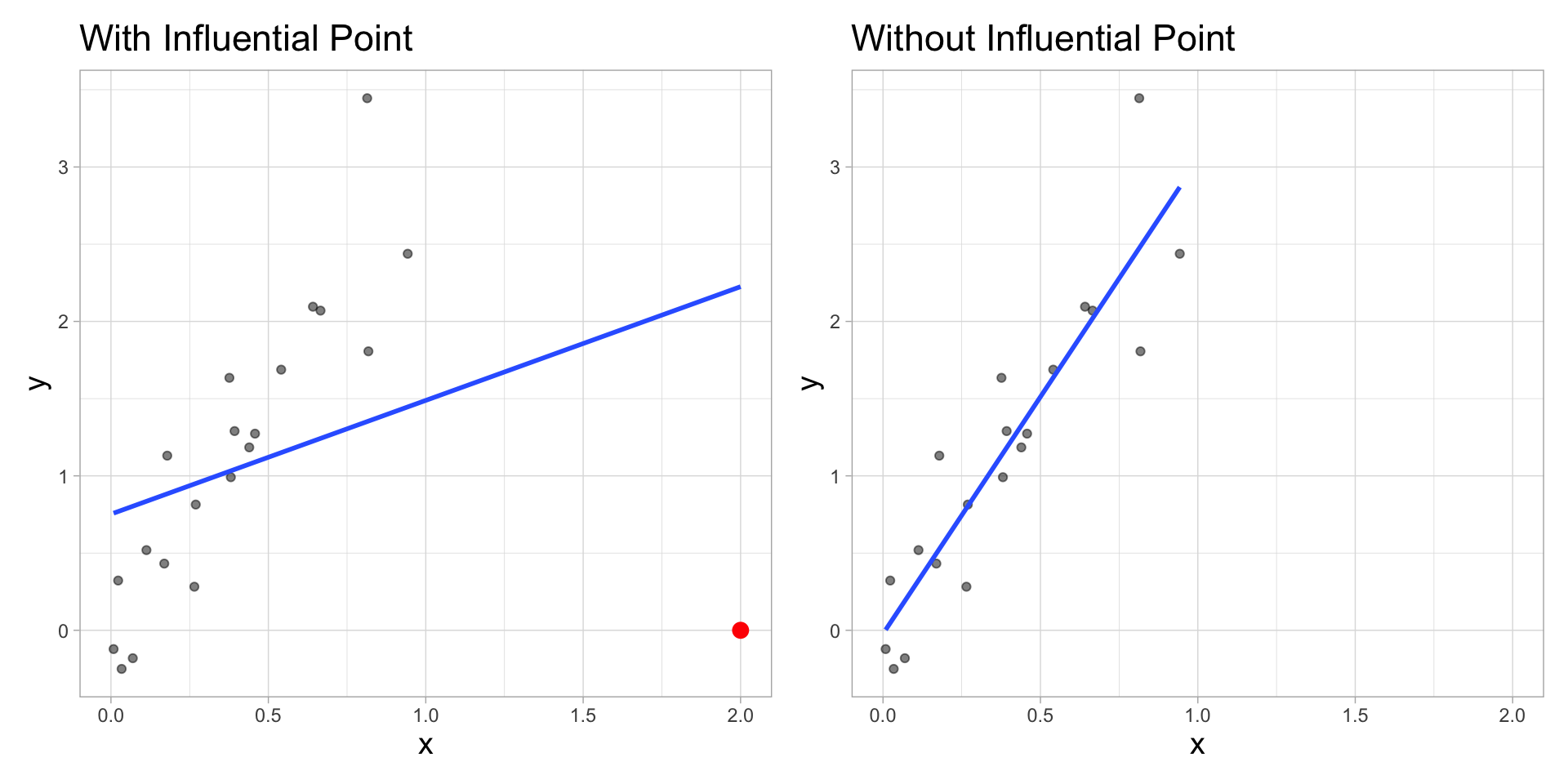
Influential Point
An observation is influential if removing has a noticeable impact on the regression coefficients
Cook’s Distance
Cook’s distance for the \(i^{th}\) observation is
\[ D_i = \frac{r^2_i}{p + 1}\Big(\frac{h_{ii}}{1 - h_{ii}}\Big) \]
where \(r_i\) is the studentized residual and \(h_{ii}\) is the leverage for the \(i^{th}\) observation
This measure is a combination of
How well the model fits the \(i^{th}\) observation
How far the \(i^{th}\) observation is from the rest of the data
Using Cook’s Distance
An observation with large value of \(D_i\) is said to have a strong influence on the predicted values
General thresholds .An observation with
\(D_i > 0.5\) is moderately influential
\(D_i > 1\) is very influential
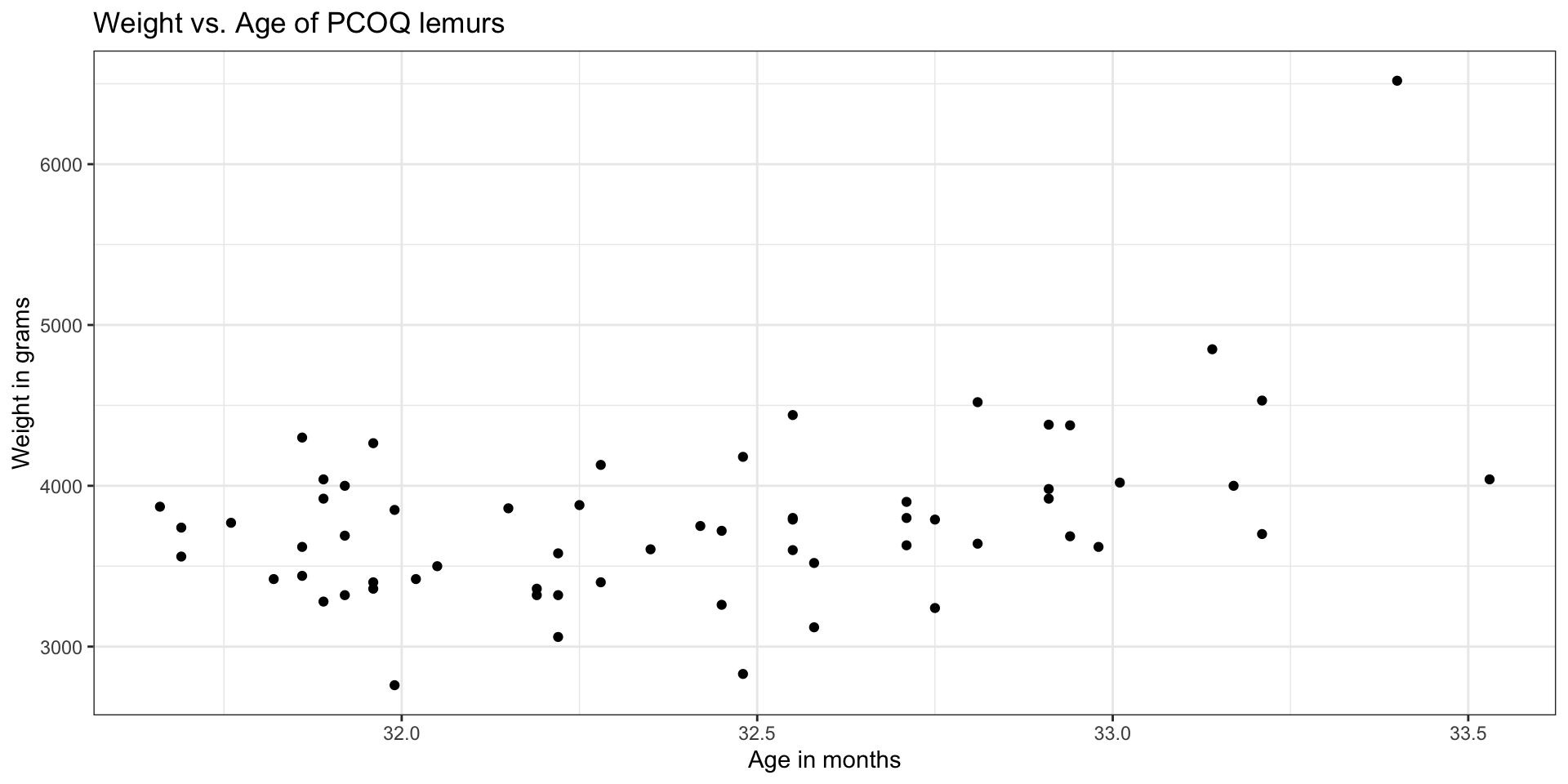
Lemurs data
Large leverage
Measure of how far the predictor (combination of predictors) is from the typical value (combination)
The sum of the leverages for all points is \(p + 1\), where \(p\) is the number of predictors in the model . More specifically
\[ \sum_{i=1}^n h_{ii} = \text{rank}(\mathbf{H}) = \text{rank}(\mathbf{X}) = p+1 \]
The average value of leverage, \(h_{ii}\), is \(\bar{h} = \frac{(p+1)}{n}\)
An observation has large leverage if \[h_{ii} > \frac{2(p+1)}{n}\]
Scaled residuals
What is the best way to identify outlier points that don’t fit the pattern from the regression line?
- Look for points that have large residuals
We can rescale residuals and put them on a common scale to more easily identify “large” residuals
We will consider two types of scaled residuals: standardized residuals and studentized residuals
Standardized residuals
The variance of the residuals can be estimated by the mean squared residuals (MSR) \(= \frac{SSR}{n - p - 1} = \hat{\sigma}^2_{\epsilon}\)
We can use MSR to compute standardized residuals
\[ std.res_i = \frac{e_i}{\sqrt{MSR}} \]
Standardized residuals are produced by
augment()in the column.std.resid
Using standardized residuals
We can examine the standardized residuals directly from the output from the augment() function
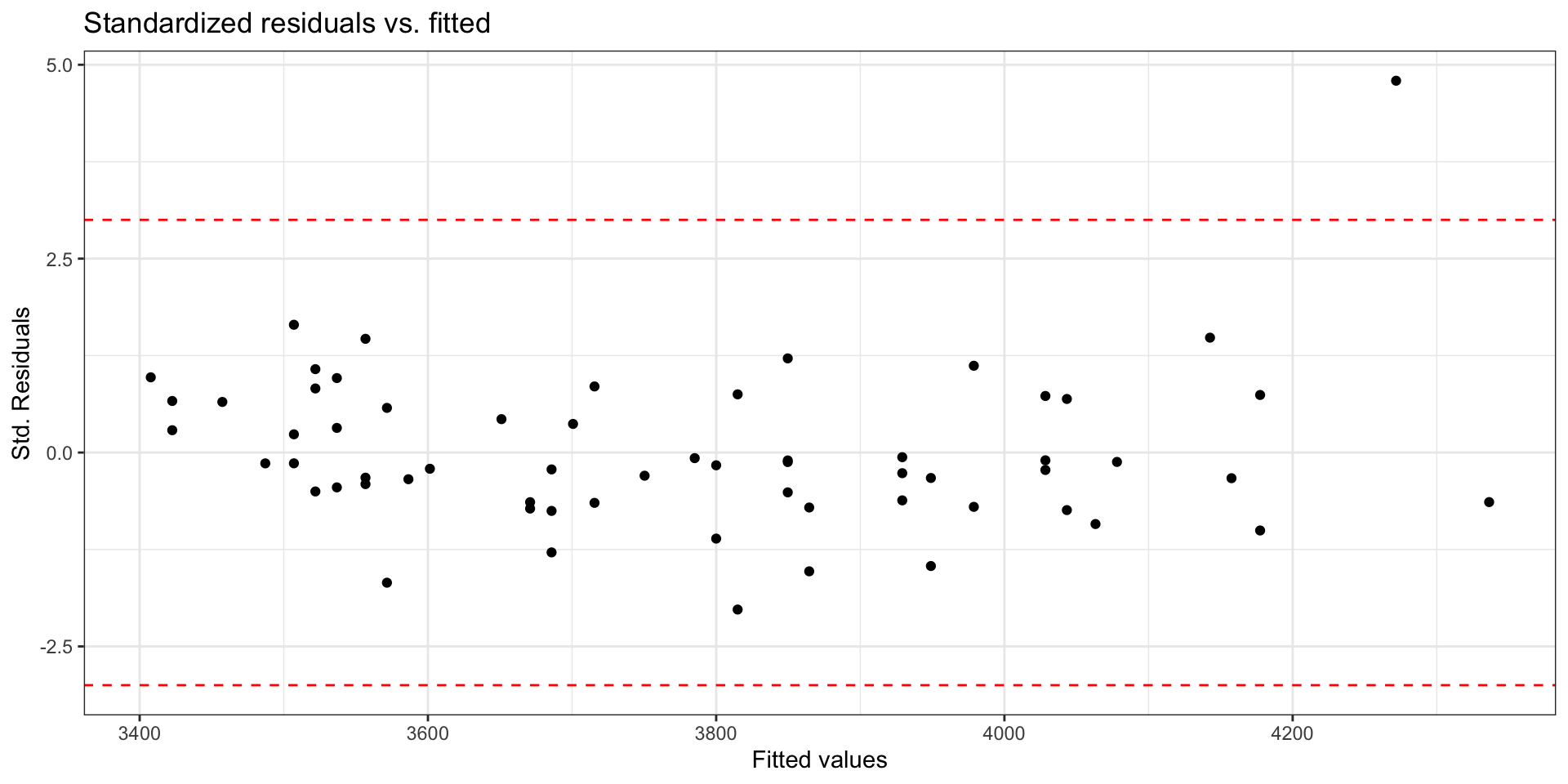
- An observation is a potential outlier if its standardized residual is beyond \(\pm 3\)
Studentized residuals
MSR is an approximation of the variance of the residuals.
The variance of the residuals is \(Var(\mathbf{e}) = \sigma^2_{\epsilon}(\mathbf{I} - \mathbf{H})\)
- The variance of the \(i^{th}\) residual is \(Var(e_i) = \sigma^2_{\epsilon}(1 - h_{ii})\)
The studentized residual is the residual rescaled by the more exact calculation for variance
\[ r_i = \frac{e_{i}}{\sqrt{\hat{\sigma}^2_{\epsilon}(1 - h_{ii})}} \]
- Standardized and studentized residuals provide similar information about which points are outliers in the response.
- Studentized residuals are used to compute Cook’s Distance.
Using these measures
Standardized residuals, leverage, and Cook’s Distance should all be examined together
Examine plots of the measures to identify observations that are outliers, high leverage, and may potentially impact the model.
Back to the influential point
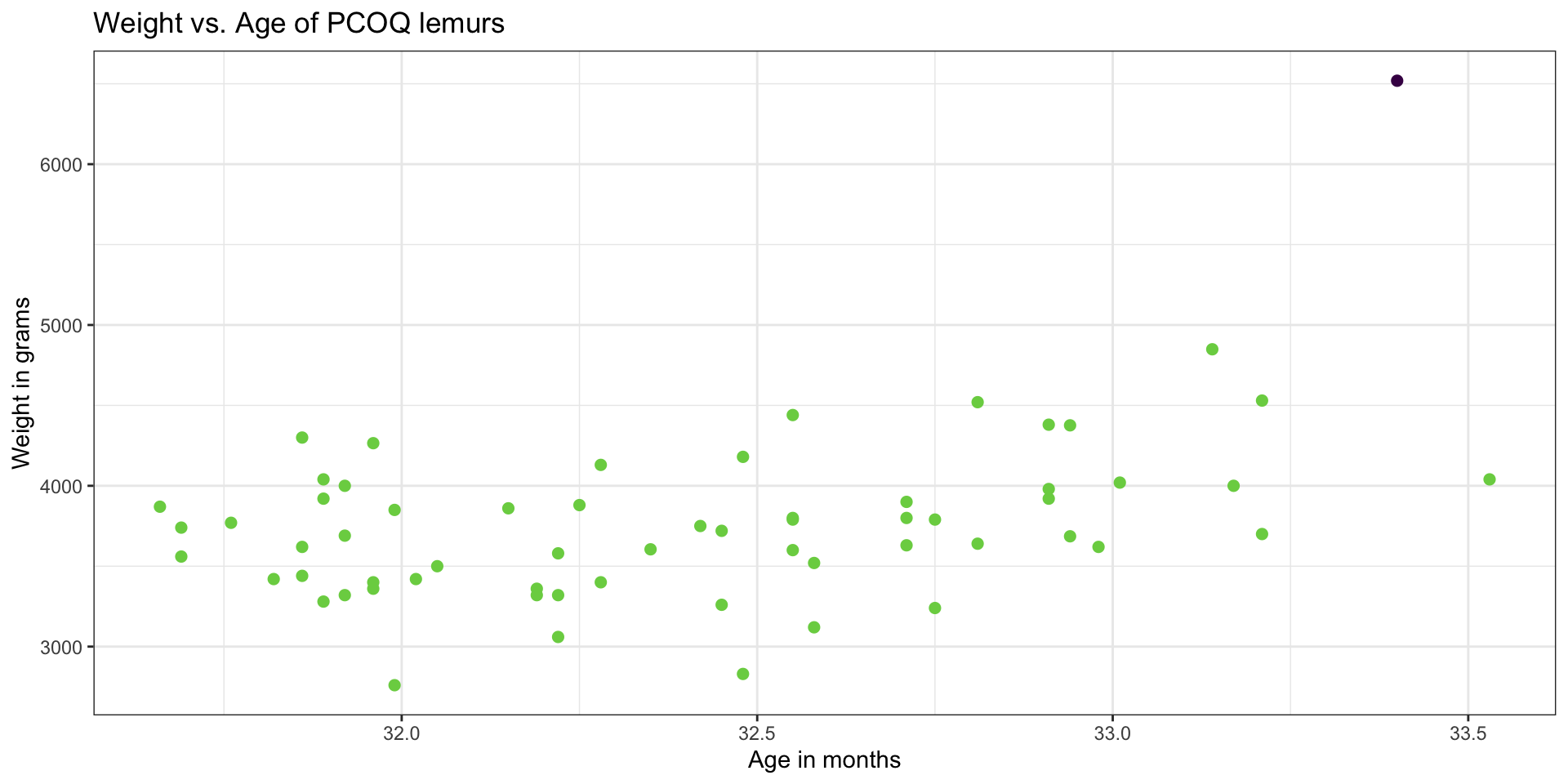
What to do with outliers/influential points?
First consider if the outlier is a result of a data entry error.
If not, you may consider dropping an observation if it’s an outlier in the predictor variables if…
It is meaningful to drop the observation given the context of the problem
You intended to build a model on a smaller range of the predictor variables. Mention this in the write up of the results and be careful to avoid extrapolation when making predictions
What to do with outliers/influential points?
It is generally not good practice to drop observations that ar outliers in the value of the response variable
These are legitimate observations and should be in the model
You can try transformations or increasing the sample size by collecting more data
A general strategy when there are influential points is to fit the model with and without the influential points and compare the outcomes
Multicollinearity
Data: Trail users
- The Pioneer Valley Planning Commission (PVPC) collected data at the beginning a trail in Florence, MA for ninety days from April 5, 2005 to November 15, 2005 to
- Data collectors set up a laser sensor, with breaks in the laser beam recording when a rail-trail user passed the data collection station.
# A tibble: 5 × 7
  volume hightemp avgtemp season cloudcover precip day_type
   <dbl>    <dbl>   <dbl> <chr>       <dbl>  <dbl> <chr>
1    501       83    66.5 Summer       7.60  0     Weekday
2    419       73    61   Summer       6.30  0.290 Weekday
3    397       74    63   Spring       7.5   0.320 Weekday
4    385       95    78   Summer       2.60  0     Weekend
5    200       44    48   Spring      10     0.140 Weekday
Source: Pioneer Valley Planning Commission via the mosaicData package.
Variables
Response
volumeestimated number of trail users that day (number of breaks recorded)
Predictors
hightempdaily high temperature (in degrees Fahrenheit)avgtempaverage of daily low and daily high temperature (in degrees Fahrenheit)seasonone of “Fall”, “Spring”, or “Summer”precipmeasure of precipitation (in inches)
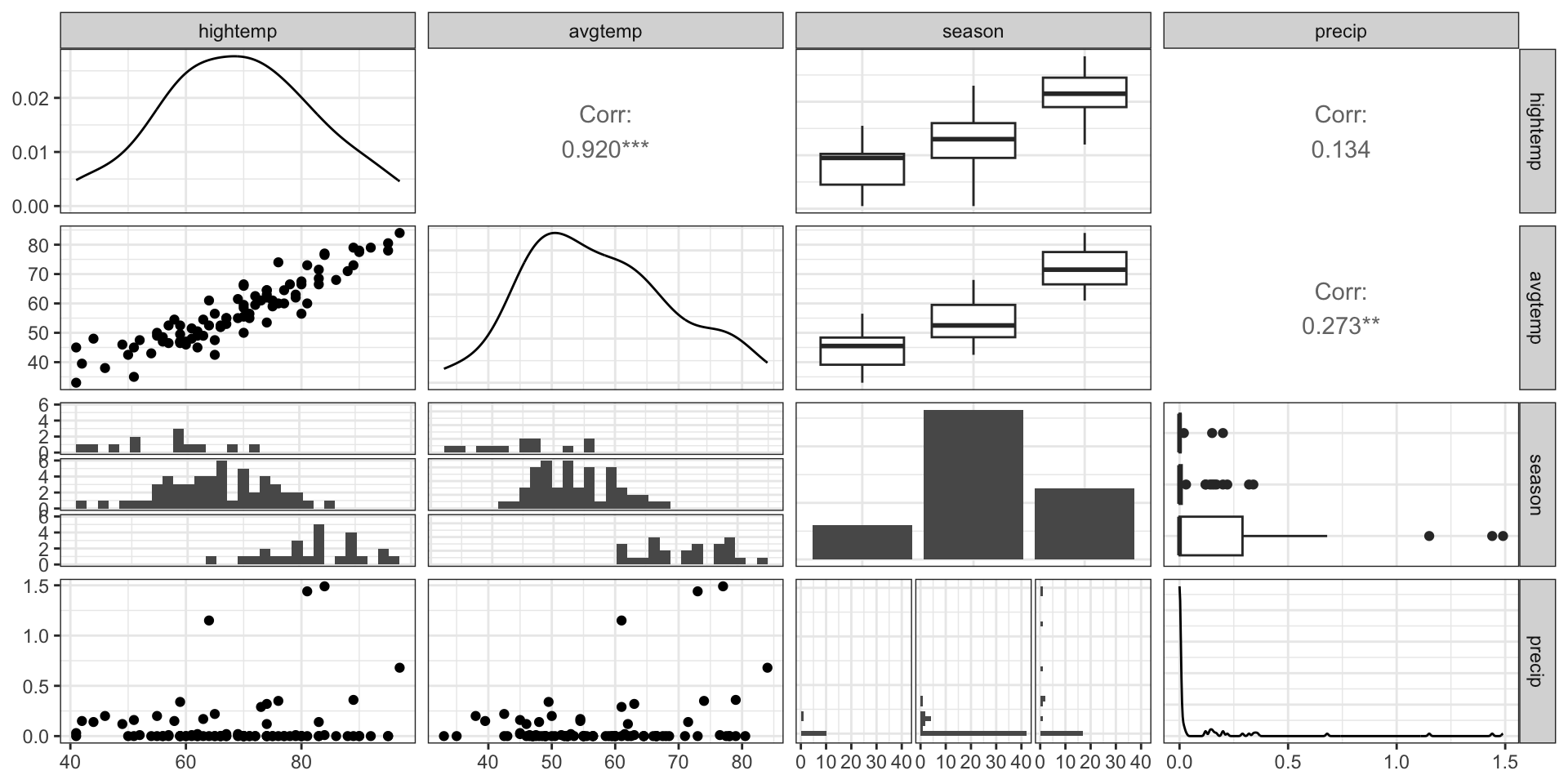
EDA: Relationship between predictors
We can create a pairwise plot matrix using the ggpairs function from the GGally R package
EDA: Relationship between predictors
EDA: Correlation matrix
We can. use corrplot() in the corrplot R package to make a matrix of pairwise correlations between quantitative predictors
EDA: Correlation matrix
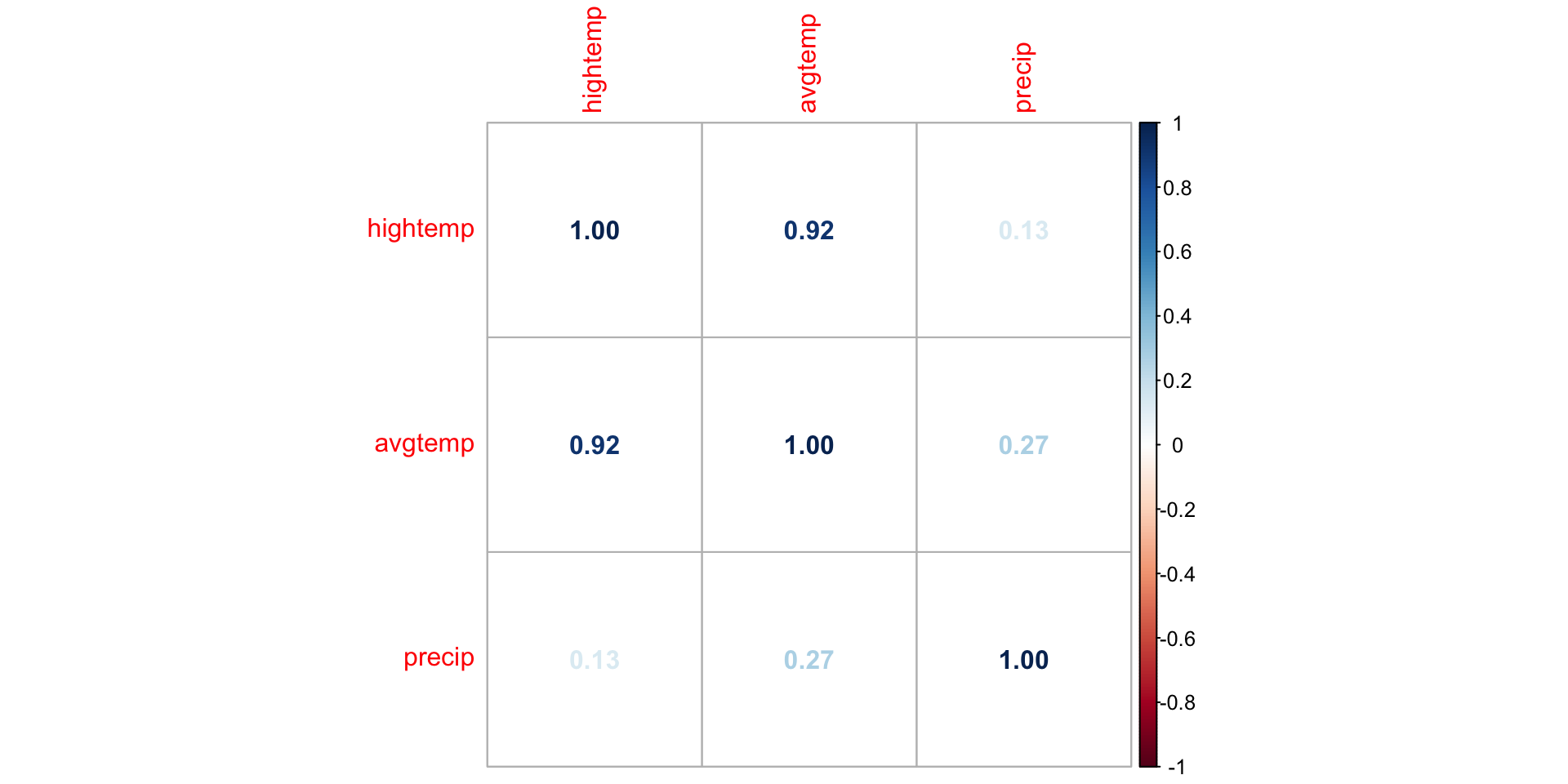
What might be a potential concern with a model that uses high temperature, average temperature, season, and precipitation to predict volume?
Multicollinearity
Multicollinearity
Ideally the predictors are orthogonal, meaning they are completely independent of one another
In practice, there is typically some dependence between predictors but it is often not a major issue in the model
If there is linear dependence among (a subset of) the predictors, we cannot find \(\hat{\boldsymbol{\beta}}\)
If there are near-linear dependencies, we can find \(\hat{\boldsymbol{\beta}}\) but there may be other issues with the model
Multicollinearity: near-linear dependence among predictors
Sources of multicollinearity
Data collection method - only sample from a subspace of the region of predictors
Constraints in the population - e.g., predictors family income and size of house
Choice of model - e.g., adding high order terms to the model
Overdefined model - have more predictors than observations
Detecting multicollinearity
- Recall \(Var(\hat{\boldsymbol{\beta}}) = \sigma^2_{\epsilon}(\mathbf{X}^\mathsf{T}\mathbf{X})^{-1}\)
- Let \(\mathbf{C} = (\mathbf{X}^\mathsf{T}\mathbf{X})^{-1}\). Then \(Var(\hat{\beta}_j) = \sigma^2_{\epsilon}C_{jj}\)
- When there are near-linear dependencies, \(C_{jj}\) increases and thus \(Var(\hat{\beta}_j)\) becomes inflated
- \(C_{jj}\) is associated with how much \(Var(\hat{\beta}_j)\) is inflated due to \(x_j\) dependencies with other predictors
Variance inflation factor
- The variance inflation factor (VIF) measures how much the linear dependencies impact the variance of the predictors
\[ VIF_{j} = \frac{1}{1 - R^2_j} \]
where \(R^2_j\) is the proportion of variation in \(x_j\) that is explained by a linear combination of all the other predictors
- When the response and predictors are scaled in a particular way, \(C_{jj} = VIF_{j}\). Click here to see how.
Detecting multicollinearity
Common practice uses threshold \(VIF > 10\) as indication of concerning multicollinearity (some say VIF > 5 is worth investigation)
Variables with similar values of VIF are typically the ones correlated with each other
Use the
vif()function in the rms R package to calculate VIF
How multicollinearity impacts model
Large variance for the model coefficients that are collinear
- Different combinations of coefficient estimates produce equally good model fits
Unreliable statistical inference results
- May conclude coefficients are not statistically significant when there is, in fact, a relationship between the predictors and response
Interpretation of coefficient is no longer “holding all other variables constant”, since this would be impossible for correlated predictors
Application exercise
Dealing with multicollinearity
Collect more data (often not feasible given practical constraints)
Redefine the correlated predictors to keep the information from predictors but eliminate collinearity
- e.g., if \(x_1, x_2, x_3\) are correlated, use a new variable \((x_1 + x_2) / x_3\) in the model
For categorical predictors, avoid using levels with very few observations as the baseline
Remove one of the correlated variables
- Be careful about substantially reducing predictive power of the model
Application exercise
Recap
Reviewed model conditions and diagnostics
Introduced multicollinearity and how it impacts a model
Next class
Variable transformations
Complete Lecture 13 prepare