library(tidyverse)
library(tidymodels)
library(pROC)
library(knitr)
library(kableExtra)

# set default theme in ggplot2
ggplot2::theme_set(ggplot2::theme_bw())Logistic Regression
Model selection
Announcements
Presentation comments due TODAY at 11:59pm
Statistics experience due April 2 at 11:59pm
Next project milestone: Draft report due April 10 (before lab)
Presentations
Model selection
Topics
- Comparing models using AIC and BIC
Computational setup
Risk of coronary heart disease
This data set is from an ongoing cardiovascular study on residents of the town of Framingham, Massachusetts. We want to examine the relationship between various health characteristics and the risk of having heart disease.
high_risk:- 1: High risk of having heart disease in next 10 years
- 0: Not high risk of having heart disease in next 10 years
age: Age at exam time (in years)totChol: Total cholesterol (in mg/dL)currentSmoker: 0 = nonsmoker, 1 = smokereducation: 1 = Some High School, 2 = High School or GED, 3 = Some College or Vocational School, 4 = College
Modeling risk of coronary heart disease
Using age, totChol, and currentSmoker
| term | estimate | std.error | statistic | p.value | conf.low | conf.high |
|---|---|---|---|---|---|---|
| (Intercept) | -6.673 | 0.378 | -17.647 | 0.000 | -7.423 | -5.940 |
| age | 0.082 | 0.006 | 14.344 | 0.000 | 0.071 | 0.094 |
| totChol | 0.002 | 0.001 | 1.940 | 0.052 | 0.000 | 0.004 |
| currentSmoker1 | 0.443 | 0.094 | 4.733 | 0.000 | 0.260 | 0.627 |
Review: ROC Curve + Model fit
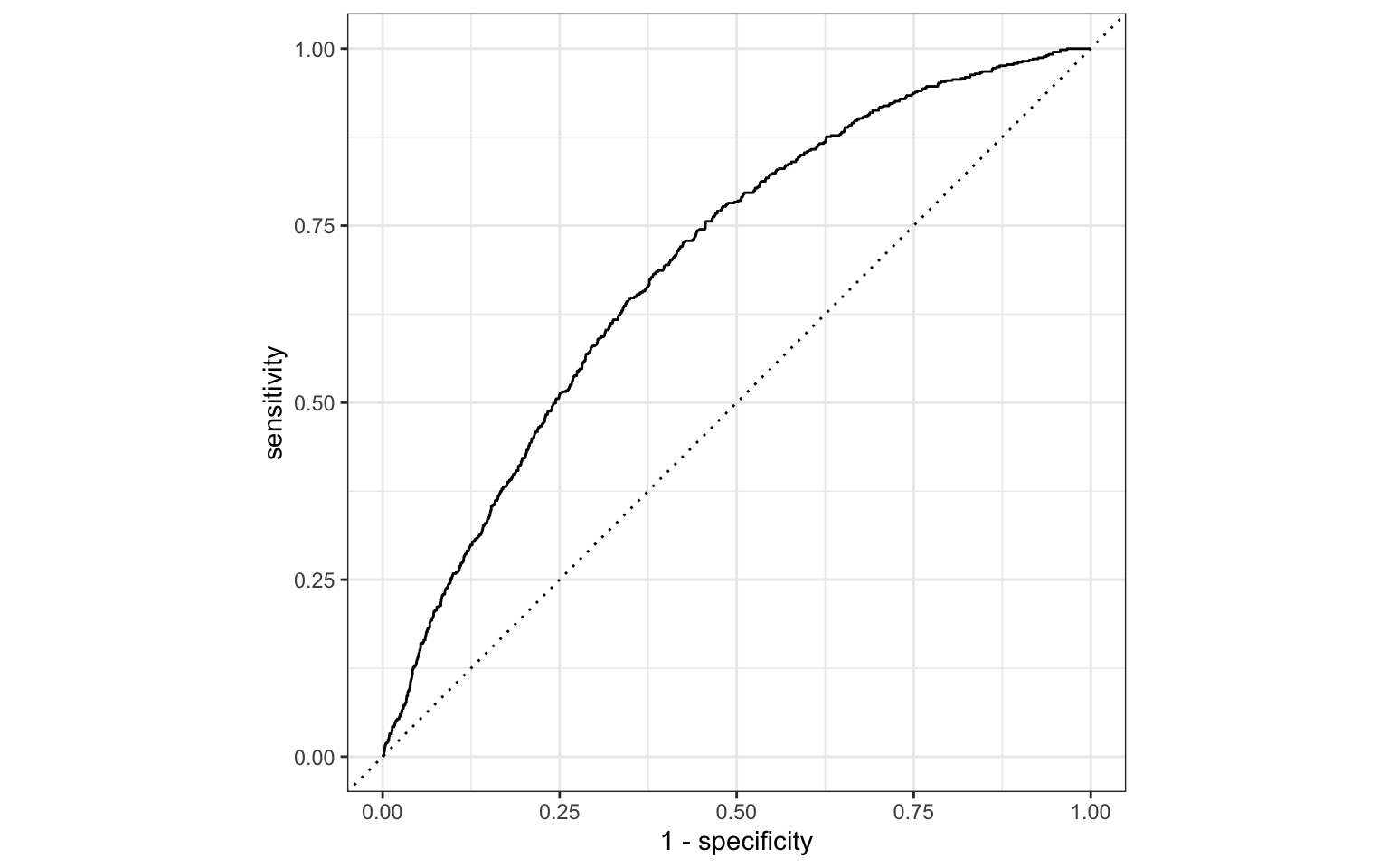
# A tibble: 1 × 3
  .metric .estimator .estimate
  <chr>   <chr>          <dbl>
1 roc_auc binary         0.697
Review: Classification
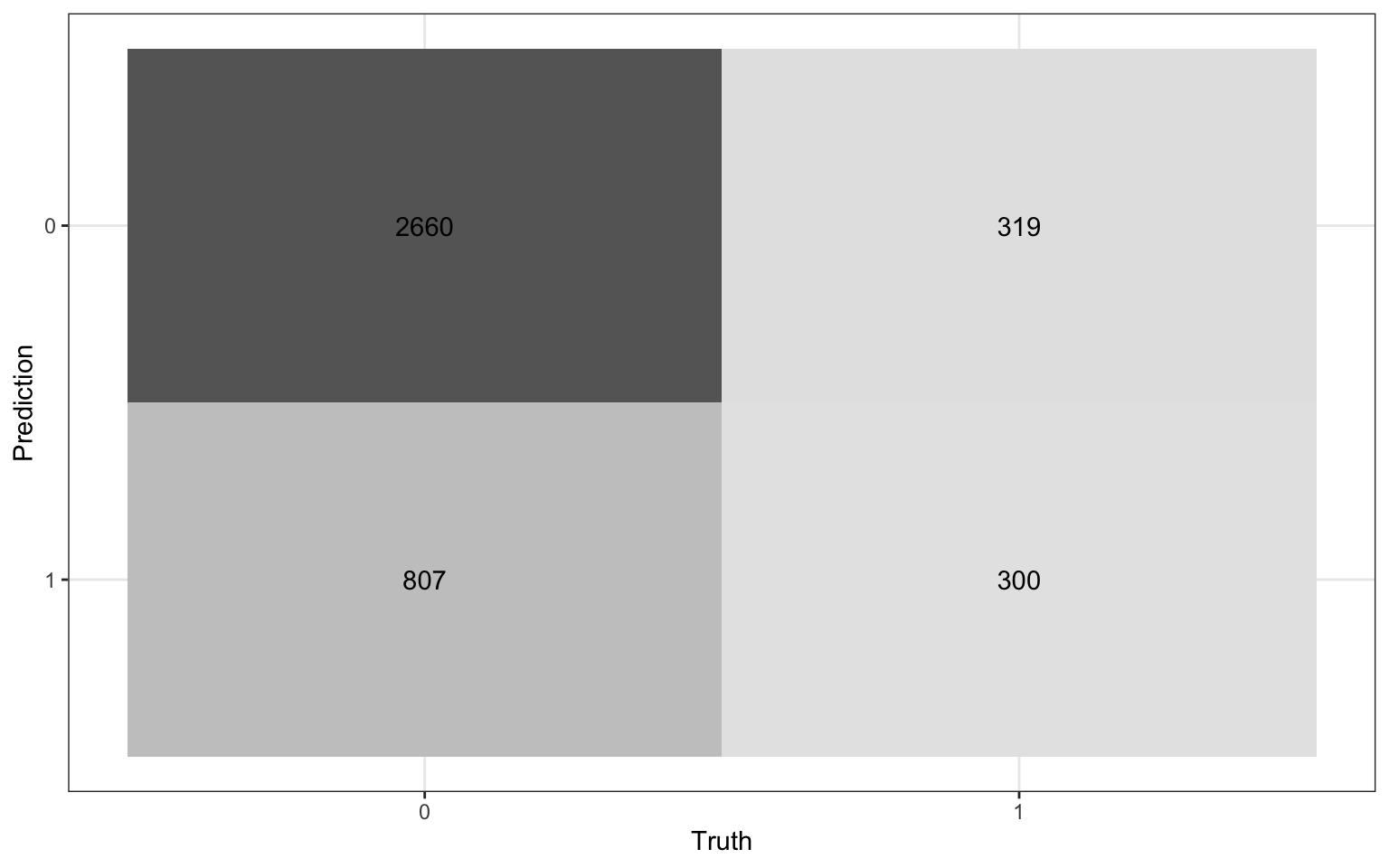
We will use a threshold of 0.2 to classify observations
Review: Classification
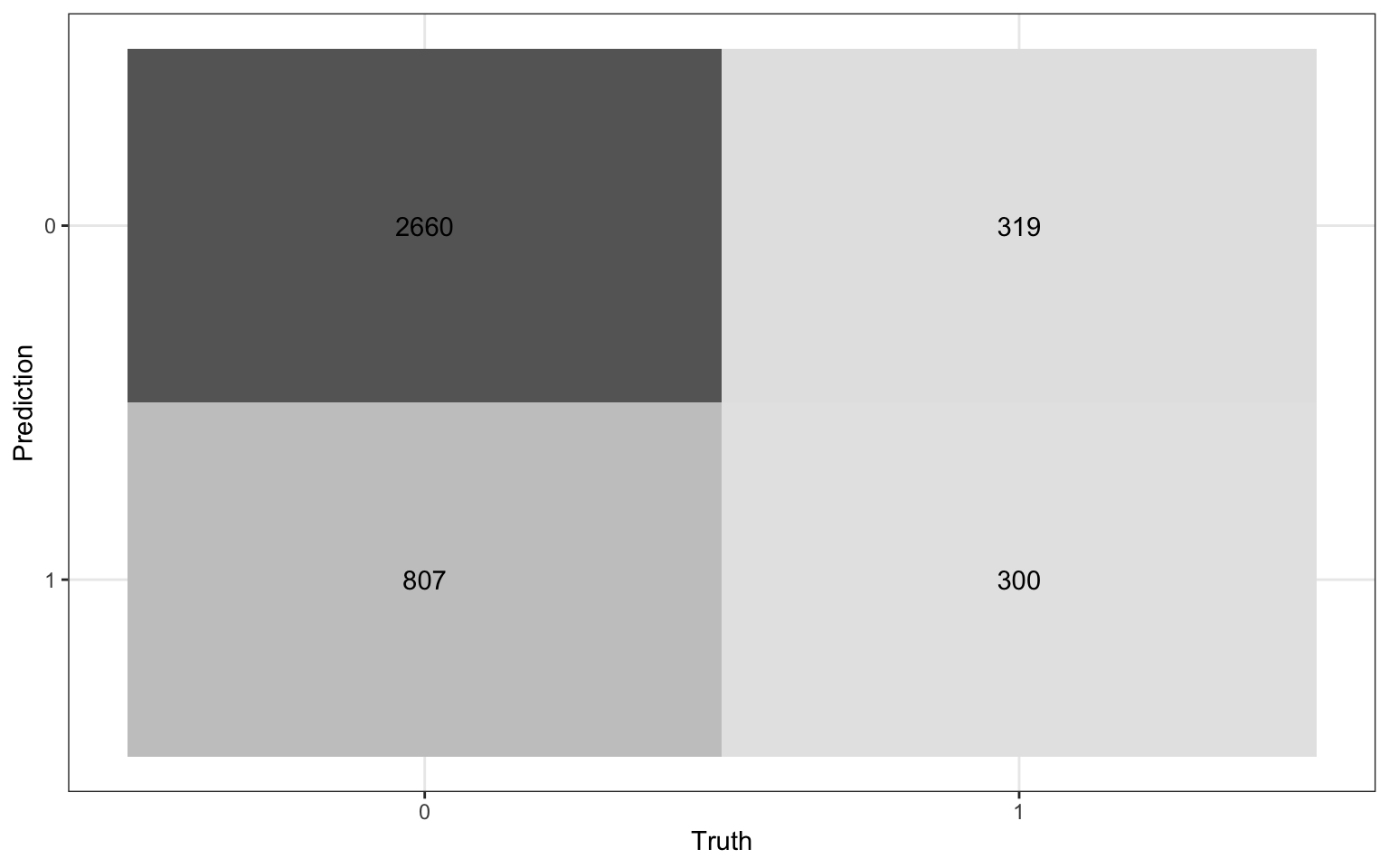
Compute the misclassification rate.
Compute sensitivity and explain what it means in the context of the data.
Compute specificity and explain what it means in the context of the data.
Model comparison
Which model do we choose?
| term | estimate |
|---|---|
| (Intercept) | -6.673 |
| age | 0.082 |
| totChol | 0.002 |
| currentSmoker1 | 0.443 |
| term | estimate |
|---|---|
| (Intercept) | -6.456 |
| age | 0.080 |
| totChol | 0.002 |
| currentSmoker1 | 0.445 |
| education2 | -0.270 |
| education3 | -0.232 |
| education4 | -0.035 |
Log-Likelihood
Recall the log-likelihood function
\[ \begin{aligned} \log L&(\boldsymbol{\beta}|x_1, \ldots, x_n, y_1, \dots, y_n) \\ &= \sum\limits_{i=1}^n[y_i \log(\pi_i) + (1 - y_i)\log(1 - \pi_i)] \end{aligned} \]
where \(\pi_i = \frac{\exp\{\mathbf{x}_i^\mathsf{T}\boldsymbol{\beta}\}}{1 + \exp\{\mathbf{x}_i^\mathsf{T}\boldsymbol{\beta}\}}\)
AIC & BIC
Estimators of prediction error and relative quality of models:
. . .
Akaike’s Information Criterion (AIC)1: \[AIC = -2\log L + 2 (p+1)\]
. . .
Schwarz’s Bayesian Information Criterion (BIC)2: \[ BIC = -2\log L + \log(n)\times(p+1)\]
AIC & BIC
\[ \begin{aligned} & AIC = \color{blue}{-2\log L} \color{black}{+ 2(p+1)} \\ & BIC = \color{blue}{-2\log L} + \color{black}{\log(n)\times(p+1)} \end{aligned} \]
. . .
First Term: Decreases as p increases
AIC & BIC
\[ \begin{aligned} & AIC = -2\log L + \color{blue}{2(p+1)} \\ & BIC = -2\log L + \color{blue}{\log(n)\times (p+1)} \end{aligned} \]
Second term: Increases as p increases
Using AIC & BIC
\[ \begin{aligned} & AIC = -2\log L + \color{red}{2(p+1)} \\ & BIC = -2 \log L + \color{red}{\log(n)\times(p+1)} \end{aligned} \]
Choose model with the smaller value of AIC or BIC
If \(n \geq 8\), the penalty for BIC is larger than that of AIC, so BIC tends to favor more parsimonious models (i.e. models with fewer terms)
AIC from the glance() function
Let’s look at the AIC for the model that includes age, totChol, and currentSmoker
glance(high_risk_fit)$AIC[1] 3232.812. . .
Calculating AIC
- 2 * glance(high_risk_fit)$logLik + 2 * (3 + 1)[1] 3232.812Comparing the models using AIC
Let’s compare the full and reduced models using AIC.
# AIC reduced model
glance(high_risk_fit_reduced)$AIC
[1] 3232.812# AIC full model
glance(high_risk_fit_full)$AIC[1] 3231.6Based on AIC, which model do you select?
Comparing the models using BIC
Let’s compare the full and reduced models using BIC
# BIC reduced model
glance(high_risk_fit_reduced)$BIC
[1] 3258.074# BIC full model
glance(high_risk_fit_full)$BIC[1] 3275.807Based on BIC, which model do you select?
Recap
Introduced model selection for logistic regression using
- AIC and BIC
Next class
Inference for logistic regression
Complete Lecture 21 prepare
References
Footnotes
Akaike, Hirotugu. “A new look at the statistical model identification.” IEEE transactions on automatic control 19.6 (1974): 716-723.↩︎
Schwarz, Gideon. “Estimating the dimension of a model.” The annals of statistics (1978): 461-464.↩︎